
Drip Check · 14 October 2026
Drip Check 04: Claude Como, a wall that grew for four years
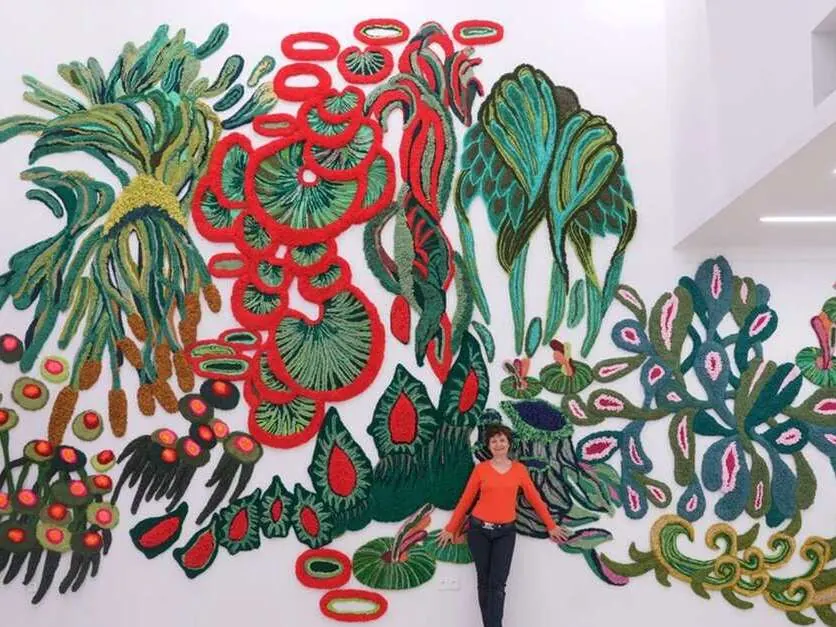
Claude Como spent nearly three decades painting roses, portraits and icons before she found a tufting gun online in 2019. She used it to do something painting had never let her do: get rid of the frame.
The work
Como was born in Marseille in 1964 and spent her childhood in Abidjan, Côte d’Ivoire, where her father worked as a chemist, before returning to France at sixteen. After a fine arts degree in Aix-en-Provence she settled in Paris, where she showed paintings at the Barbier-Beltz gallery from 1993 and founded the Le Triage art centre in Nanterre in 2002. One long-running project, Rosacerdoce, placed a thousand painted rose portraits inside a greenhouse at the Parc de Saint-Cloud in 2004.
She moved back to Marseille in 2012 and discovered tufting in 2019. She uses the gun the way she once used paint, but free of the canvas edge, cutting each piece loose once the wool is down. The results are organic and oversized: mushrooms that reach three metres, tangled roots, leaves that spread across an entire wall. Her 2024 show Sweet Symphony, at the Palais de l’Europe in Menton, ran until September and hung 130 tufted pieces across sixty linear metres, all made over four years. She calls the results “d’immenses doudous”, giant comfort blankets, standing in for a connection to nature she thinks modern life has lost.
© Claude Como. Source: letufting.fr
What we see as makers
Scale is a decision, not an accident. Como tufts small motifs, then groups and repeats them until a piece reads as sixty metres of wall, or blows a single mushroom up to three metres. On a single panel a tufter can borrow the same move: repeat one shape at very different sizes and the wall starts to feel alive instead of flat.
Nothing has to stay inside its rectangle. She builds her installations from loose tufted cells rather than one fixed canvas, so a piece can wrap a corner or run around a doorway. Cutting a tufted shape free of its frame and mounting it straight on the wall does the same thing at a smaller scale.
Touch is part of the design, not an afterthought. She describes part of Sweet Symphony as a “prière de toucher”, a request to touch. That is a choice made at the tufting stage: piles kept long and loose enough that a hand running over the surface finds something, not just an eye looking from across the room.
The drip connection
Como frees wool from the frame and lets it spread across a wall. Jan Fechner’s drip tufting, developed at BUBU Studio, frees colour inside the frame instead, letting one hue run into the next as the gun keeps moving. Both start from the same refusal to leave a colour exactly where it was first put down. Como lets the whole piece wander off the canvas. Jan lets the canvas itself keep moving.
Want to test your own limits with a tufting gun? Book a session in Paphos.
Sources: Lola Bosco, “‘Sweet Symphony’: Exposition tufting de Claude Como”, LeTufting, 5 June 2024, letufting.fr. Martine Gatti, “Carquefou. Plongez dans la Supra Folia de la plasticienne Claude Como”, Unidivers, 14 January 2025, unidivers.fr. Artist biography, artsy.net/artist/claude-como. Quotes translated from French.
Try it with yarn in your hands.
Tufting workshops in Paphos, every week.