
Drip Check · 16 October 2026
Drip Check 06: Andy Welland, a mural the length of a football pitch
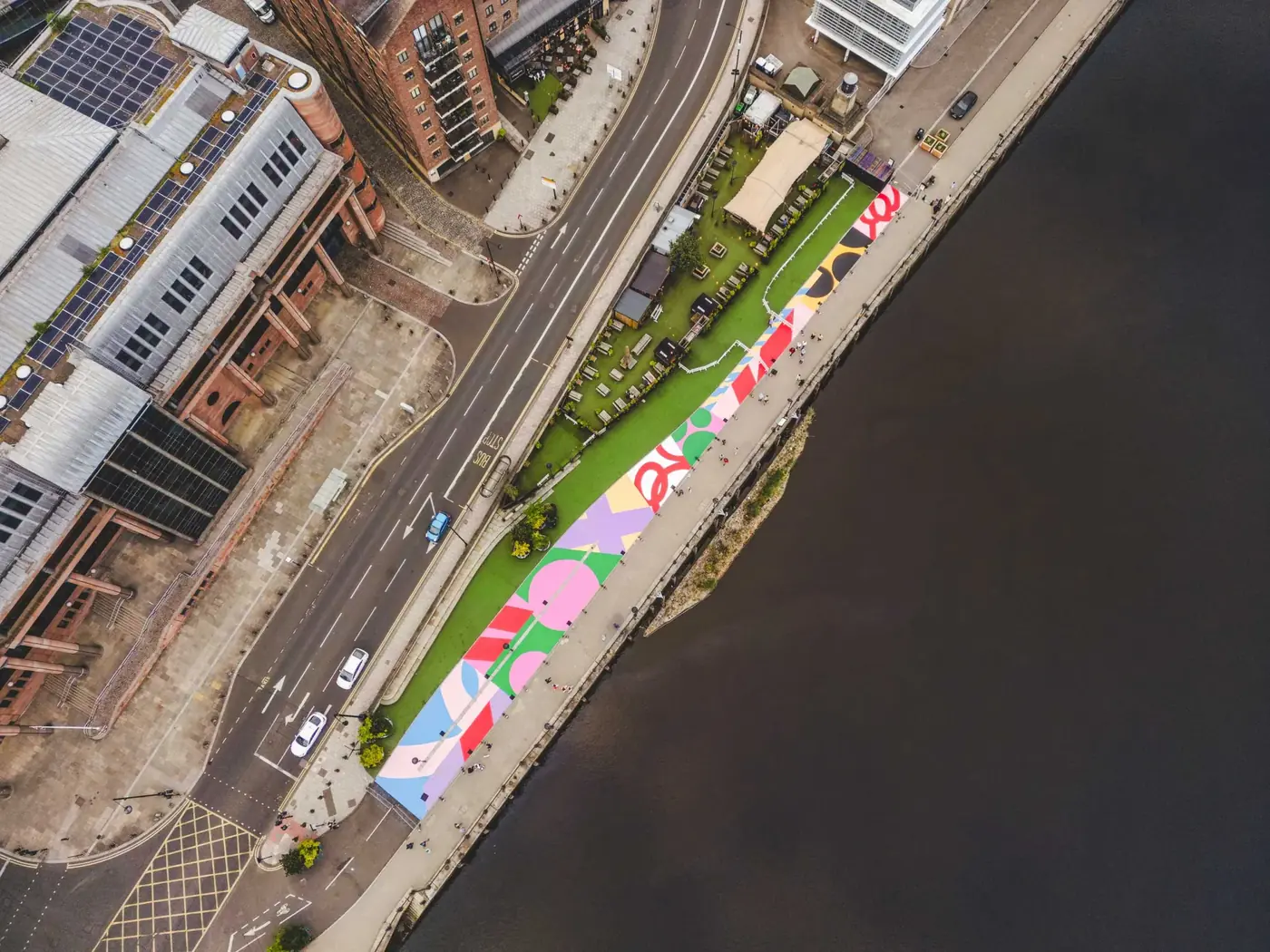
Andy Welland’s biggest canvas in 2024 was not a canvas at all. It was ninety metres of disused bus lane.
The work
Welland is a British artist and art director working in the UK, raised in Doncaster and based in Sheffield. He finished a Fine Art degree at Sheffield Hallam University in 2007, then started his career in London advertising, working in the luxury division of M&C Saatchi before moving into design studios and his own practice. His work since has stayed close to collage: flat, bold shapes locked together into kaleidoscopic compositions, carried across murals, screenprints, sculpture and packaging for clients including Selfridges, Liberty London, Lush and Anthropologie.
He calls his recurring mural and print series “Loose Ends,” numbering each piece as it appears in a new place. The 2024 edition, Loose Ends 300, was commissioned by the Newcastle business initiative NE1 and curated by Unit44 Gallery. Welland painted it directly onto a former bus lane on the Quayside, along the River Tyne, in a blue herringbone pattern broken up by blocks of yellow and pink. At ninety metres it is believed to be the largest piece of temporary pavement art in the UK. “Loose Ends 300 is a graphic collage inspired by the energy of the River Tyne,” he said of the piece.
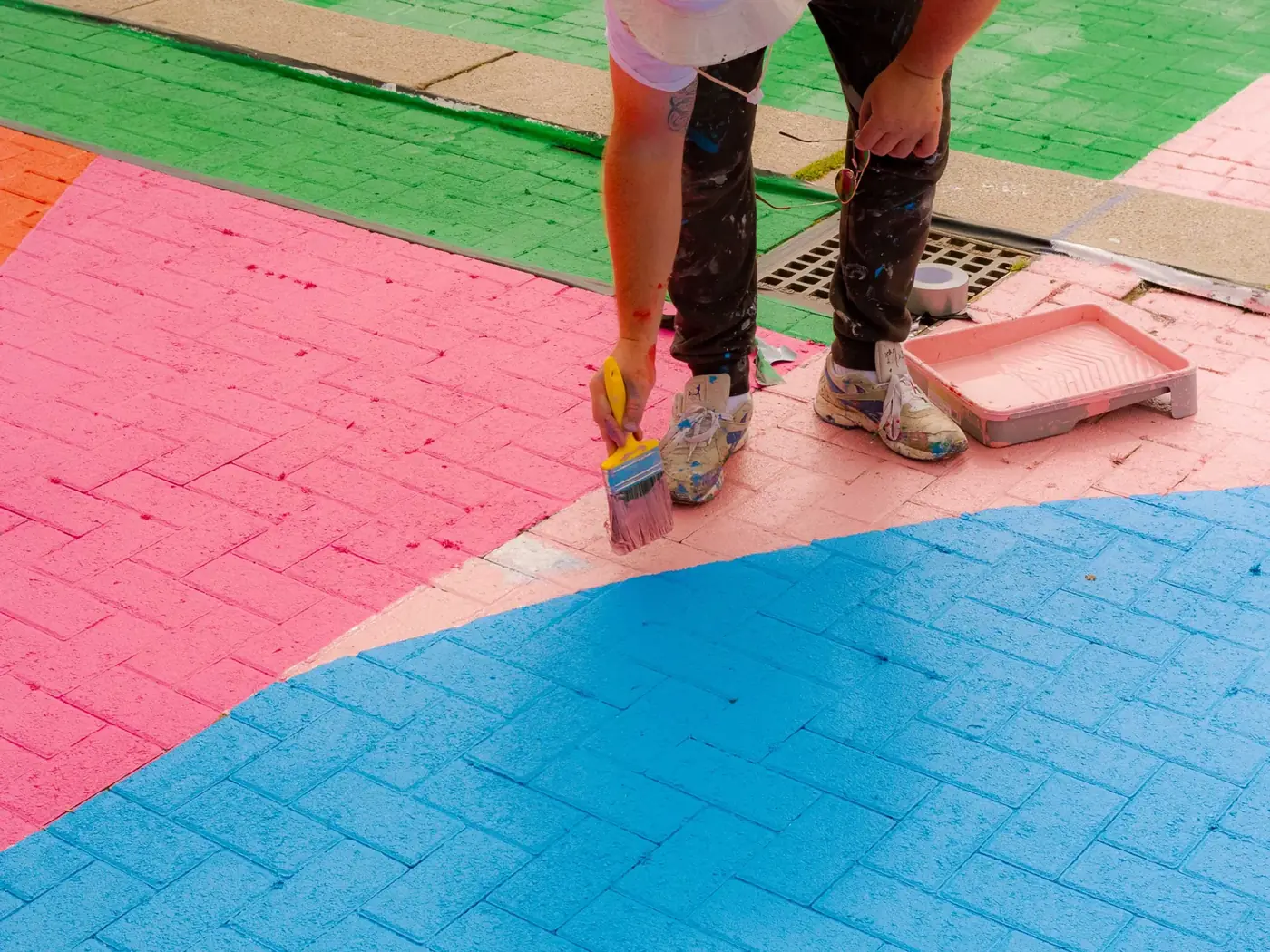 © Andy Welland. Source: creativeboom.com
What we see as makers
A module can carry a mural further than a single big image can. Loose Ends 300 reads as one long piece, but it is built from a repeating herringbone tile broken by colour blocks. A tufter can scale up the same way: design one small unit, then let repetition and spacing do the work of filling a large panel, rather than planning every square centimetre from scratch.
A numbered series frees you from starting blank every time. Welland has painted dozens of Loose Ends pieces, each one a fresh take on the same underlying idea rather than an unrelated new design. Keeping a running set of shapes or colour combinations to pull from and adapt saves a tufter from re-inventing a composition for every new piece.
Public colour has to read from far away and up close. The Quayside mural works as an aerial photograph and as a surface someone walks across. Welland keeps his shapes large and his colours few so both views hold up. The same test is worth running on a tufted panel: does it still read clearly from across the room, not only from the chair in front of it.
The drip connection
Welland paints his colour blocks straight onto hard ground and keeps every edge crisp, tile next to tile, colour next to colour, nothing bleeding into its neighbour. Jan Fechner’s drip tufting, developed at BUBU Studio, does the opposite on purpose. He lets wool run from one colour into the next as the gun moves, so the border itself becomes part of the image instead of a line to protect. Welland’s mural proves how far a hard edge can travel, metre after metre of pavement. Jan’s drip tufting proves what happens the moment that edge is allowed to move.
See how far a colour can travel in your own panel. Book a session in Paphos.
Sources: Tom May, “Andy Welland paints a rainbow and 90 metres of fun for Newcastle’s Quayside”, Creative Boom, 17 July 2024, creativeboom.com. Artist biography, bearsofsheffield.com/people/andy-wellend-loose-ends. Artist website, andywelland.com.
Try it with yarn in your hands.
Tufting workshops in Paphos, every week.