
Drip Check · 18 October 2026
Drip Check 08: Hense, scale learned on the street
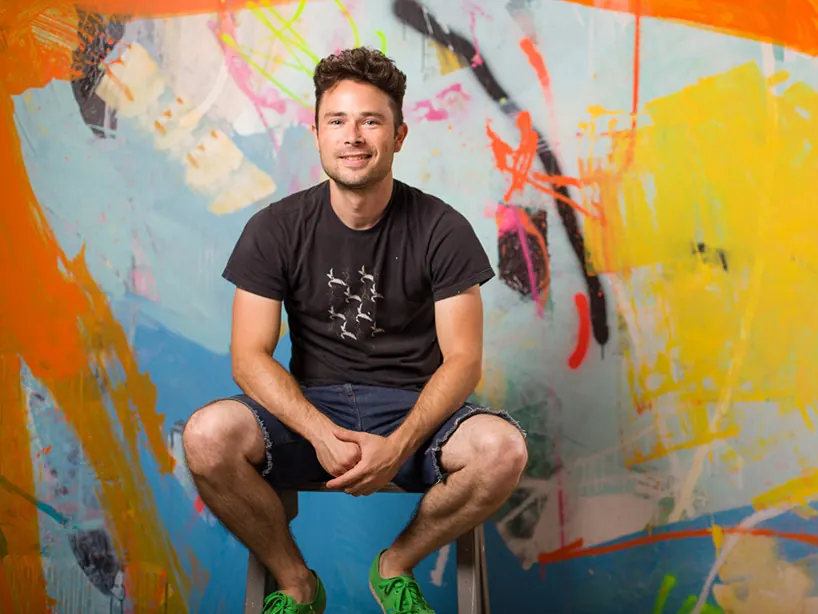
Alex Brewer painted his first tag at thirteen, under a name that stuck: Hense.
The work
Brewer grew up in Atlanta and started writing graffiti in the early 1990s, working fast across the city until he had what graffiti culture calls all-city status, a tag in nearly every neighbourhood. He left Virginia Commonwealth University after one semester to keep painting outdoors. In 2000 he took a job at an art publishing company with its own studio, and for years he ran two tracks at once: street walls at night, studio work by day. By 2002 he was taking paid commissions, and has spent the two decades since moving between galleries, public commissions and architecture.
His work stays abstract: biomorphic shapes, dense layered colour and compositions that curator Michael Rooks of the High Museum of Art describes as combining “the quick pace and point-of-view of street culture with tumultuous compositions.” His largest piece to date covers a wall at the ISIL Institute in Lima, Peru, around 40 metres tall. He has also painted a set of grain silos in Northam, Western Australia, a three-building commission called Building Blocks in Hagerstown, Maryland, and a site-specific wall drawing inside the High Museum itself.
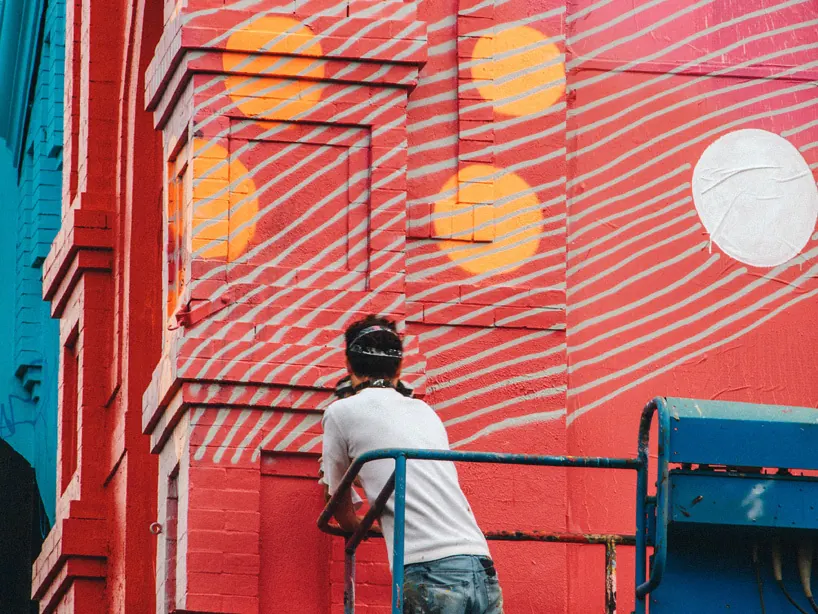 © Alex Brewer. Photo: Miguel “M.i.G.” Martinez. Source: designboom.com
What we see as makers
Two tracks can train one practice. Brewer learned scale outdoors, painting fast at night, and learned studio patience during the day at a publishing job. Neither track replaced the other. A tufter can run the same split on purpose: practise loose, fast colour decisions on scrap wool, then bring that looseness back to a slower, planned panel.
A fast-drying material changes how much you can decide on the spot. Brewer prefers water-based paints over oil because they dry quickly, which lets him build up layers and depth within a single session rather than waiting between coats. Tufting already works this way: a loop goes down finished, no drying time, which means more colour decisions can happen in one sitting than almost any other medium allows.
The wall tells you the scale, not the other way round. Brewer treats each site, a silo, a church, a lobby, as part of the composition before he paints a single line. A tufted piece benefits from the same habit: measure the actual wall and the actual light before choosing a palette, instead of designing in the abstract and hoping it fits.
The drip connection
Brewer says plainly, “I never like to plan out my work.” He builds a piece through preliminary marks and lets the composition argue with itself as he goes, trusting fast-drying paint to keep up with fast decisions. Jan Fechner’s drip tufting, developed at BUBU Studio, runs on the same trust, just with wool instead of paint. He lets one colour bleed into the next as the gun keeps moving, deciding the border in the same motion that makes it rather than planning it first. Brewer finds his shapes by painting through them. Jan finds his by letting the gun keep moving.
Want to find a shape with your hands before you plan it on paper? Book a session in Paphos.
Sources: Andy Butler, “alex brewer (HENSE) interview”, Designboom, 9 January 2014, designboom.com. Artist biography, hensethename.com/about.
Try it with yarn in your hands.
Tufting workshops in Paphos, every week.