
Drip Check · 21 October 2026
Drip Check 11: Claire Ritchie, flowers small enough to hold
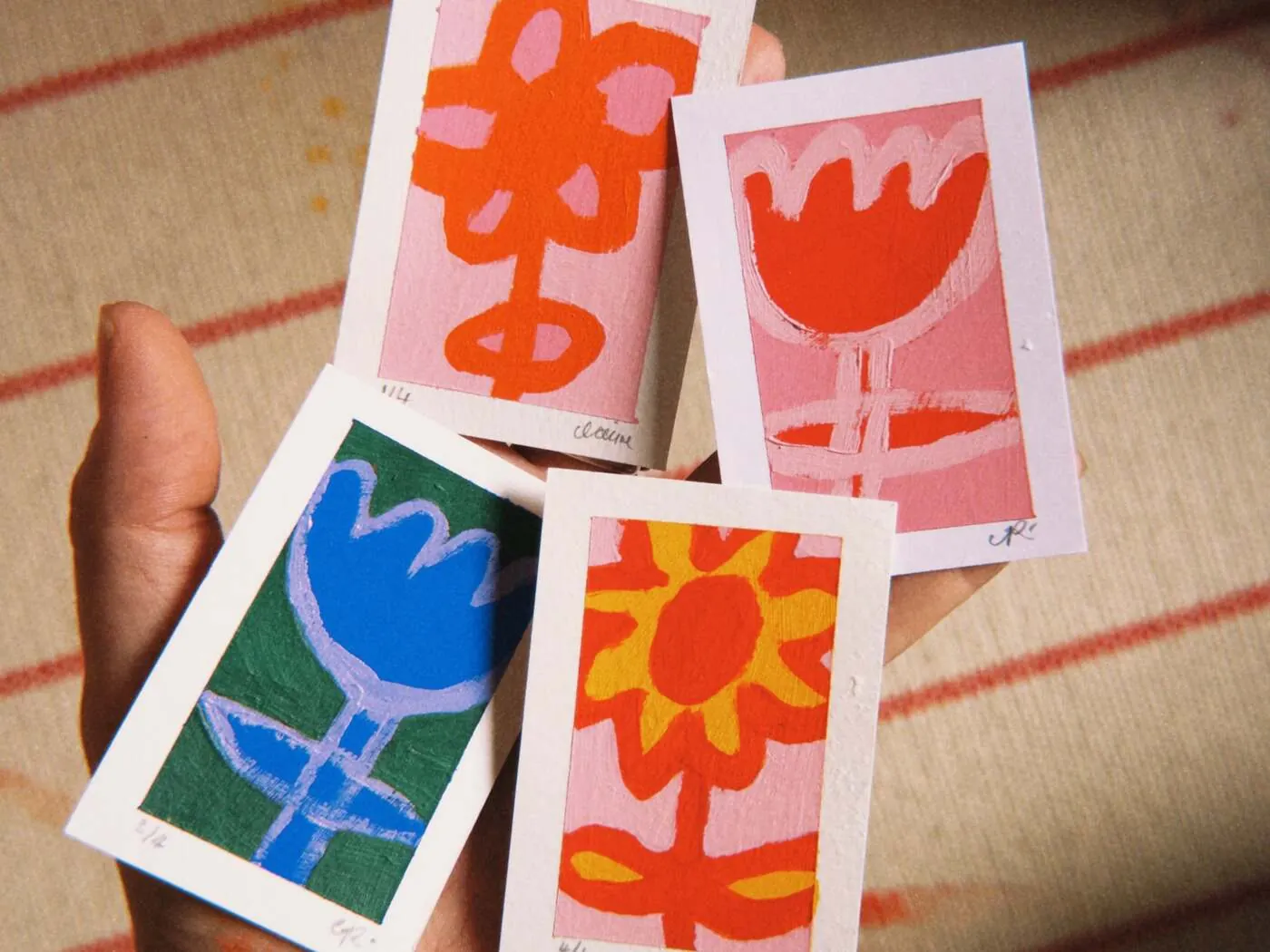
Claire Ritchie’s flowers are small enough to hold in one hand: four painted cards, signed and numbered like a limited print, each one a different bloom in its own two-colour combination.
The work
Ritchie trained in Clothing Production and Fashion and Textile Design in Perth, Western Australia. In 2013 she packed a sewing machine and a stash of fabric and moved to the east coast, building the early years of her business in Melbourne before shifting to Brisbane in 2018. She now works from a garage studio on Sydney’s Northern Beaches. The move across cities tracked a move across materials too: she started in clothing and accessories and now works mainly as a painter and illustrator, selling original paintings, paper and canvas prints, wall hangings and stationery, alongside homeware collaborations that include mugs for Robert Gordon and woven labels for KATM.
Her subject stays close to one idea: flowers, drawn loose and a little made up rather than copied from life. “Everything starts as a hand-drawn piece,” she has said of her process, sketched first with a Posca paint marker before she digitises it and adds colour, a habit she keeps even when the final piece is a painting rather than a print. In 2024 she showed new acrylic work, including the painting Let Go, in the solo exhibition Pick me at Pine Rivers Art Gallery in Strathpine, Queensland, built around her own relationship with herself.
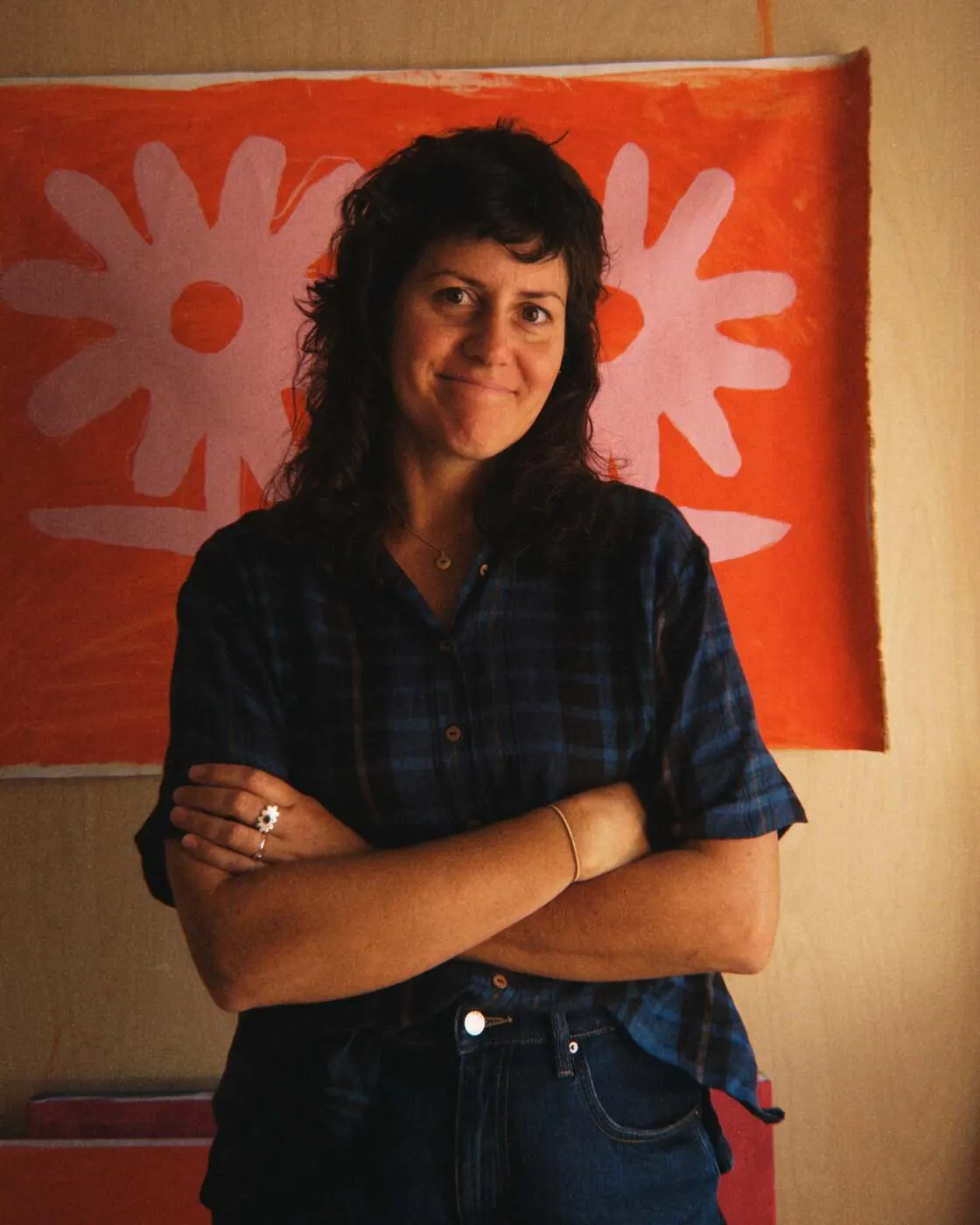 © Claire Ritchie. Source: claireritchie.com.au
What we see as makers
A scalloped edge reads as “flower” with zero extra detail. Ritchie’s petals are a single wavy line wrapped around a block of colour, no shading, no veins, no highlight, and it still reads instantly as a bloom. A tufter can lean on the same shortcut: a round, scalloped outline cut into the pile does more identifying work than any fine detail tufted inside it.
One drawn mark travels through every format. The same flower that starts as a two-inch marker sketch ends up scaled onto a canvas, a wall hanging or a ceramic mug without being redrawn from scratch. A tufter can treat a motif the same way, drawing it once at a small size and tracing that same outline up to whatever panel size is needed, instead of re-proportioning the shape each time.
A fixed shape can carry an unlimited palette. Across her small bloom cards the flower silhouettes repeat, but no two cards share a colourway: orange on pink, blue on green, yellow on red. For a tufter working through a limited scrap stash, that is a way to get variety without new shapes, by keeping one outline and simply changing which yarns fill it.
The drip connection
Ritchie’s colour stops exactly where her brush stroke stops. A scalloped petal edge is a decision made once, in one pass of the marker or the brush, and it holds. Jan Fechner’s drip tufting, developed at BUBU Studio, treats that same kind of edge as something to keep moving: wool bleeds past where a flat colour field would normally stop, so the border is never quite fixed twice in a row. Ritchie draws a shape and repeats it at any size she likes. Jan draws a shape and lets the gun blur its own edge before it is finished.
Want to see a flat shape loosen into a drip. Book a session in Paphos.
Sources: Claire Ritchie, “Art with Heart: Claire Ritchie Works One Bloom at a Time”, Peppermint Magazine, 16 October 2023, peppermintmag.com. Artist profile, People of Print, peopleofprint.com. Artist website, claireritchie.com.au.
Try it with yarn in your hands.
Tufting workshops in Paphos, every week.