
Drip Check · 25 October 2026
Drip Check 15: Hannah Bess Ross, a face for everything she draws
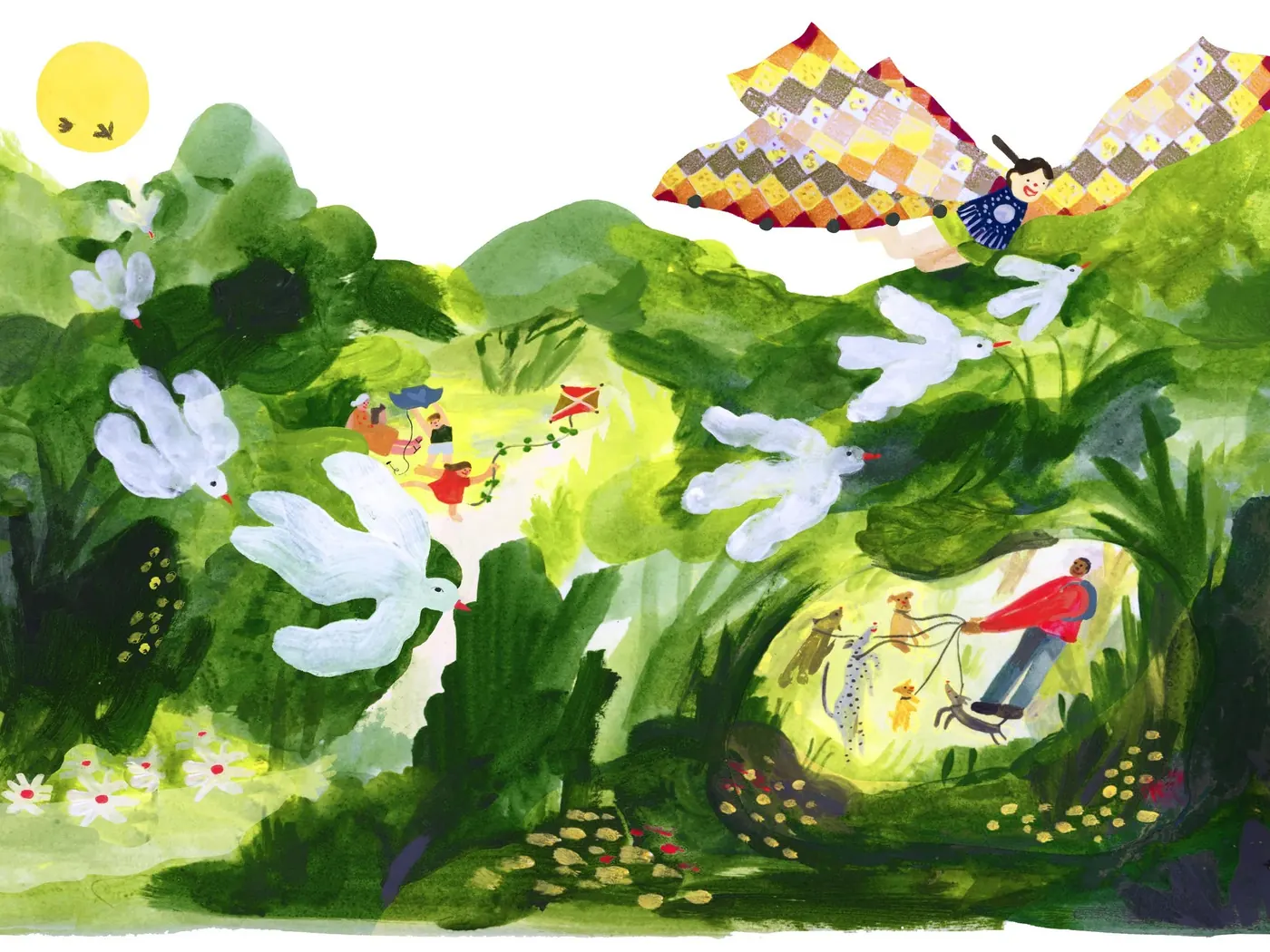
Hannah Bess Ross draws faces onto almost anything: geese, clouds, boxing bears, a car named after her favourite book. Give one of her characters two dots and a short line for a mouth, and it becomes somebody, whatever species it started as.
The work
Ross is a Chicago-based illustrator and writer. She graduated summa cum laude from the Columbus College of Art and Design in 2015 with a BFA in Illustration and Creative Writing. As a shy child she spent a lot of time inventing stories in her head, turning ordinary objects like forks and spoons into characters long before she thought to draw them. “I always knew I wanted to tell stories in some way,” she has said. After college she worked in a bakery and in bookstores and libraries while building a freelance practice for clients including Crate & Barrel Kids and Honest History Magazine. She now works as a senior artist at the Chicago studio Jellyvision alongside her own illustration and writing.
Her books include A World Full of Nature Stories by Angela McAllister (2022) and Lore of the Stars by Claire Cock-Starkey (2023), both rooted in folklore, sky and the natural world. She sketches on an iPad or on paper, paints finished pieces in gouache and watercolor, favouring Holbein acrylic gouache on smooth cardstock, then scans the result and finishes it in Photoshop. Her named influences run from Quentin Blake and Maurice Sendak to the Nova Scotia folk painter Maud Lewis and Henri Matisse, and she calls The Phantom Tollbooth by Norton Juster her all-time favourite book. Her own pieces, she says, usually start as “poems or a couple sentences of dialogue” rather than a sketch.
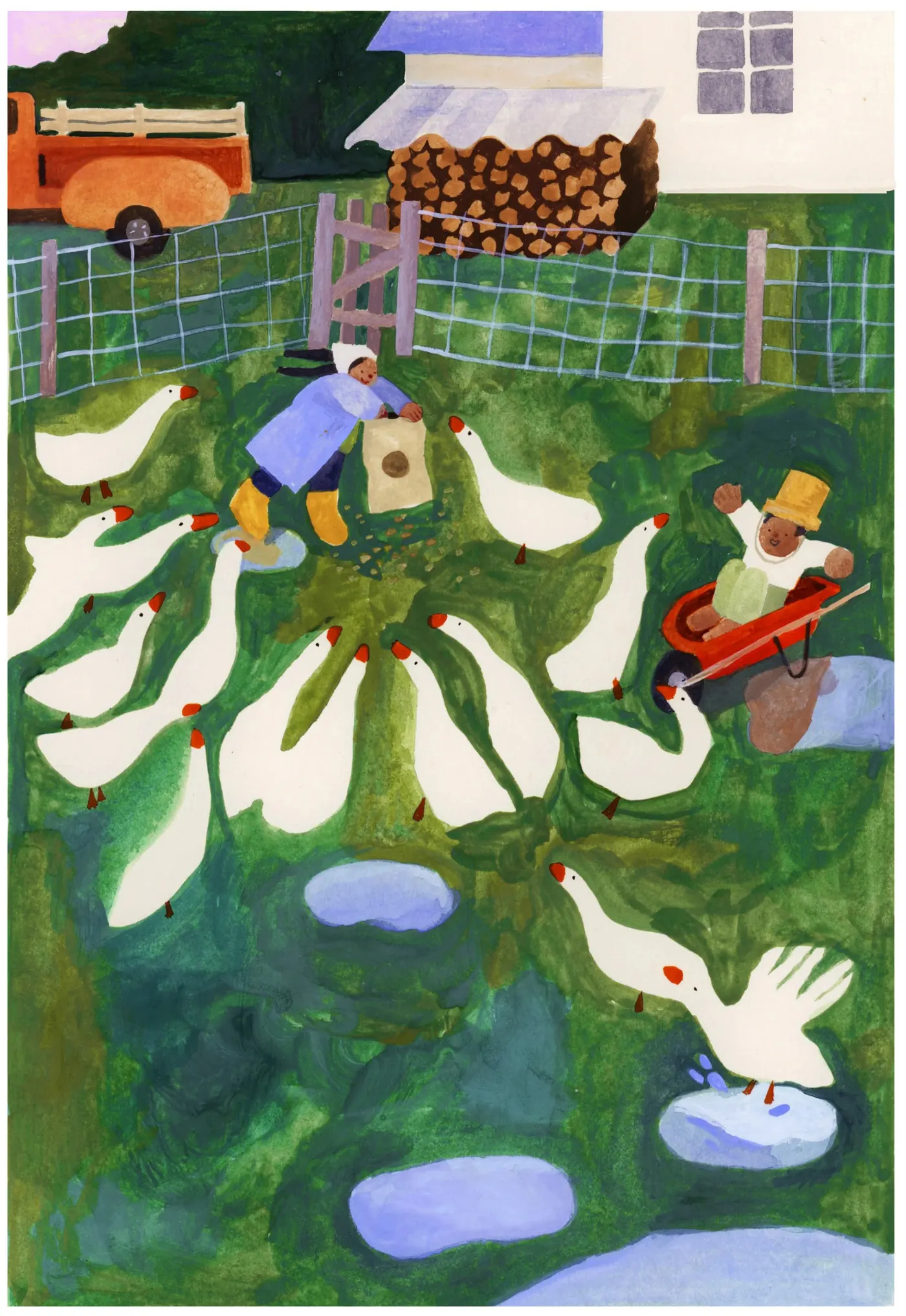 © Hannah Bess Ross. Source: hannahbessross.com
What we see as makers
A face is the fastest way into a piece. Two dots and a line turn any shape, a goose, a cloud, a boxing bear, into a character a viewer reads before anything else in the scene. A tufter stuck on an abstract panel can test the same shortcut: add the smallest suggestion of eyes to one shape and watch it pull focus from everything around it.
Repetition builds a crowd without extra decisions. In her farmyard scene a dozen geese share the same red beak and the same two black dots, repeated at different angles rather than redesigned one by one. A tufter filling a busy panel can draw one motif well, then repeat it with small changes of pose or scale instead of inventing a new shape for every space.
A story before a sketch keeps a drawing from going flat. Ross writes a line or two of dialogue before she draws, so a piece already has a reason for what is happening in it. A tufter can borrow the habit: decide what a motif is doing before cutting wool, and the piece tends to hold together even without a single literal word in it.
The drip connection
Every character Ross draws keeps its own face, its own outline, its own small identity inside a busy scene. Jan Fechner’s drip tufting, developed at BUBU Studio, works by letting identity dissolve instead: one colour is allowed to run into the next until the edge between them disappears. Ross never lets a goose blur into the grass behind it. Jan lets one patch of wool become the one next to it. Both depend on knowing exactly where an edge is, whether you are keeping it sharp or letting it go.
Curious where your own edges hold and where they could run? Book a session in Paphos.
Sources: “Hannah Bess Ross: Quirky Charm & Strange Worlds”, jamarattigan.com, 19 May 2026, jamarattigan.com. “Interview with Illustrator Hannah Bess Ross”, Honest History, honesthistory.co. Artist website and About page, hannahbessross.com/aboutme.
Try it with yarn in your hands.
Tufting workshops in Paphos, every week.