
Drip Check · 31 October 2026
Drip Check 21: Anne Roos Kleiss, one hand across five materials
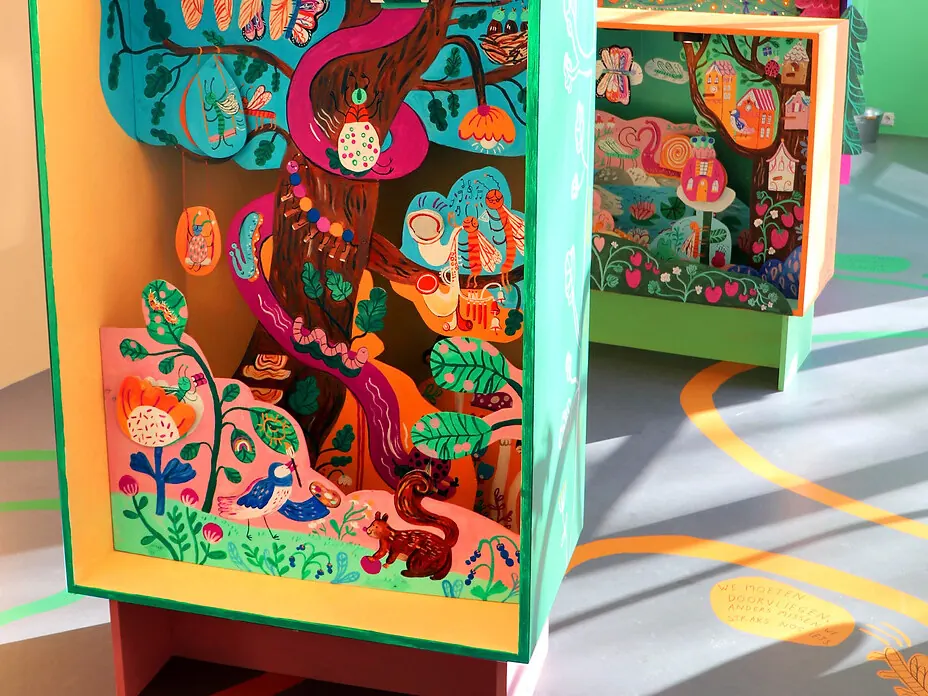
Anne Roos Kleiss has signed her work as Roozeboos, a childhood nickname, since long before it became a studio name. It travelled with her through art school, a masters in England, and a growing list of materials that now includes a tufting gun.
The work
Kleiss is based in Rotterdam, where she keeps an atelier in Keilewerf, a shared building for makers. She studied illustration at the Willem de Kooning Academy in Rotterdam, then took a master’s in children’s book illustration at Cambridge School of Art, finishing in 2020. Her work spans picture books, children’s theatre, editorial illustration, spatial design, and live drawing at events, for clients including Scholastic, HP, Querido and Groundwood Books.
Her debut picture book, Choices, follows a girl at a poolside watching others make decisions before she finally jumps from the high board herself. Kleiss sketched at a real pool first, studying how light bends underwater, then built the final spreads from crayon, marker, coloured pencil and touches of white gouache on blue paper. The book was shortlisted for the 2022 Klaus Flugge Prize. “I try to look at the world with a childlike curiosity,” she has said of her approach.
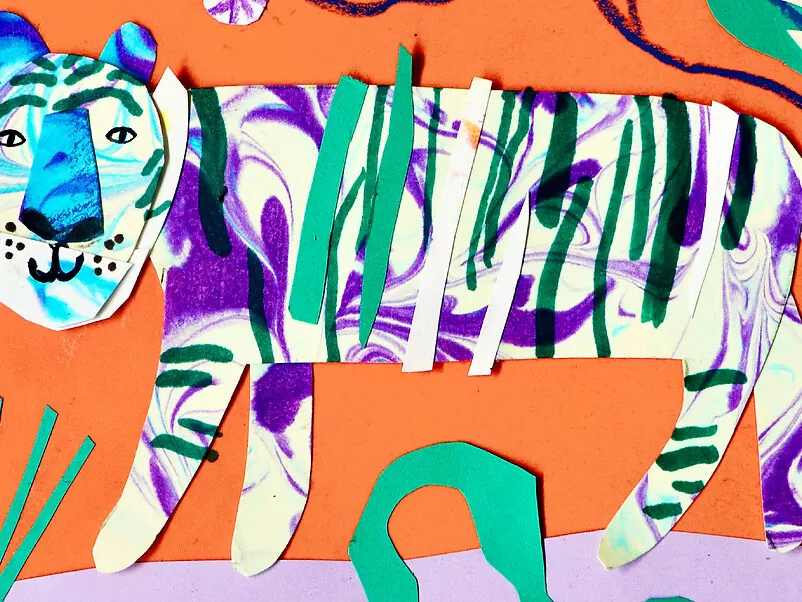 © Anne Roos Kleiss (Roozeboos). Source: roozeboos.com
Her own site lists separate project categories: riso and screen prints, papier mache objects, personal paper collages under the name My Swirly World, and tufted textile rugs. She has also painted large wooden dioramas, among them a jungle scene for an exhibition on the life of a mayfly.
What we see as makers
One drawing language can move through several materials unchanged. Kleiss draws the same playful, high-colour world whether the surface is a book page, a riso print, a papier mache object or a tufted rug. A tufter does not need a separate “tufting style”: the language that already works on paper can usually be tufted as is.
A real observation earns a simplified shape later. Before drawing a flat, graphic pool scene, Kleiss watched an actual pool: how water distorted bodies, how light behaved underwater. A tufter can do the same groundwork, sketching from a real object before reducing it to blocks of yarn.
Patterned material can stand in for a flat colour. In her tiger collage, the body is one piece of swirled marbled paper instead of a flat cut, with the stripes sitting as a separate layer on top. A tufter can borrow the trick with variegated yarn used as a fill inside a shape, saving solid colours for the lines that need to read clean.
The drip connection
Kleiss keeps her materials in separate boxes: one project in riso ink, one in papier mache, one in tufted wool, each chosen because it fits that idea best, and none of them blend into each other. Jan Fechner’s drip tufting, developed at BUBU Studio, works against that habit of sorting. Inside a single piece, one length of wool runs straight into the next colour while the gun keeps moving, so the blend happens in the material itself rather than on paper beforehand. Kleiss chooses a box for every idea. Jan opens all of them in the same pass.
Curious what happens when the boxes stop staying separate? Book a session in Paphos.
Sources: “Studio Tour with Roozeboos”, House of Anansi Press blog, 21 April 2025, houseofanansi.com. Andrea Reece, “Windows into Illustration: Roozeboos”, Books for Keeps, BfK 255, 20 July 2022, booksforkeeps.co.uk. Artist website and about page, roozeboos.com and roozeboos.com/about.
Try it with yarn in your hands.
Tufting workshops in Paphos, every week.