
Drip Check · 9 November 2026
Drip Check 30: Nathan Paddison, raw paint over a grey ground
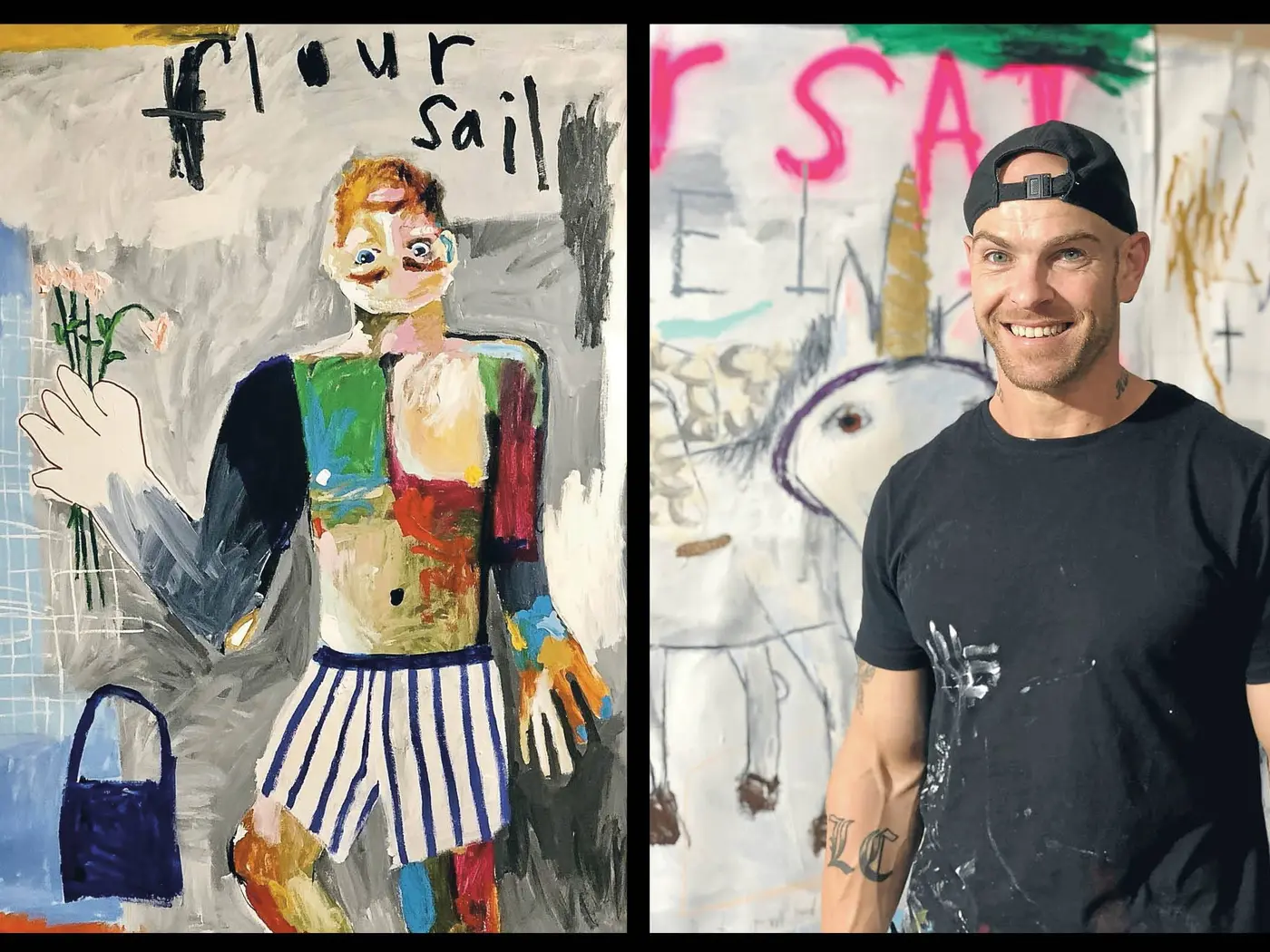
Four years after he first picked up a brush, Nathan Paddison had a $5,000 cheque for a self-portrait of himself holding flowers, and this to say about it: “I love it. I can’t stop painting.”
The work
Paddison paints out of a garage studio in Tinonee, a small town on the Manning River in New South Wales, after moving north from Sydney by way of the Central Coast and Ellalong. Before painting he worked as a personal trainer focused on Muay Thai, and he is self-taught, born in 1983. He started around 2017, first on paper, then on acrylic canvas, and within a couple of years was selling work by the hundreds. He buys canvas in large rolls rather than pre-stretched frames because it ships better, mixes colours in tubs instead of on a palette so he can return to the same batch later, and often begins a piece with a flat grey ground, then lays translucent white over it to rough out the composition before any colour goes down. He frequently keeps three canvases going at once.
In 2021 his self-portrait Flour Sail won the People’s Choice award at the Kilgour Prize, Newcastle Art Gallery’s portraiture prize, decided that year entirely by online vote while the gallery sat closed under COVID restrictions. The same year he was a finalist in the Lester Prize in Western Australia and the Naked and Nude Art Prize at Manning Regional Art Gallery. His gallery representation, now spanning Australia, Europe, Asia and North America, places him in the Art Brut and graffiti tradition, alongside influences Basquiat, Picasso and Twombly, and his subjects range from animals and childhood icons to people from his own life. “I am especially pre-occupied artistically with the struggle of addiction,” he has said of that work.
What we see as makers
A neutral underlayer can do the planning so the top layer doesn’t have to. Paddison’s grey base with translucent white over it works like a compass, setting the composition before the bold colour and line arrive. A tufter can rough out a loop guide in one plain colour first, then let the finished yarn be as wild as it wants within it.
How a material ships is part of choosing it. Buying canvas unstretched because it survives transport better is a studio decision, not an artistic one, made anyway because it kept the work moving. A tufter picking a backing cloth or panel size can weigh how the piece will travel, not only how it looks on the frame.
Running several pieces at once stops any one of them getting overworked. Paddison keeps three canvases going so none absorbs every hour of doubt in one sitting. A tufter stuck re-cutting one corner of a hoop can start a second small piece instead of grinding at the first.
The drip connection
Paddison’s grey-and-white underlayer is a leash: it tells the raw paint on top roughly where to go before anything gets loose. Jan Fechner’s drip tufting, developed at BUBU Studio, works without that leash. There is no neutral ground to return to and no guide layer laid down first, just wool meeting wool as the gun keeps moving and the edge decides itself. Paddison’s chaos happens on a line he drew in advance. Jan’s happens with no line at all.
Want to find out what a piece looks like with no grey ground under it? Book a session in Paphos.
Sources: Jim Kellar, “People’s Choice winner Nathan Paddison: ‘I can’t stop painting’”, Manning River Times / Newcastle Herald, 26 October 2021, manningrivertimes.com.au. Artist profile, Corridor Contemporary, corridorcontemporary.com/artists/92-nathan-paddison.
Try it with yarn in your hands.
Tufting workshops in Paphos, every week.