
Drip Check · 11 November 2026
Drip Check 32: Jakey Pedro, a plasterer's hands gone rodeo
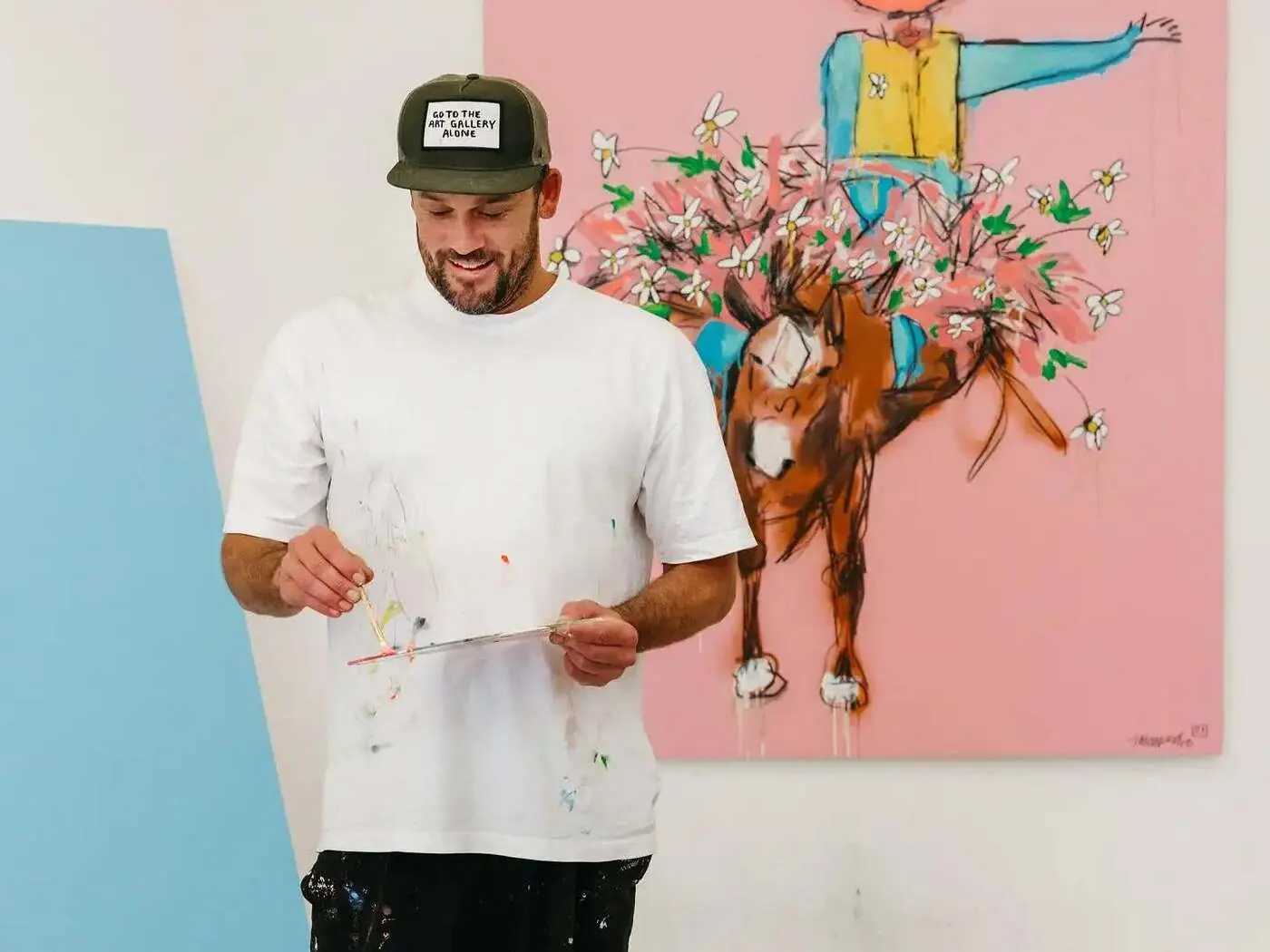
Jacob Pedrana sold his plastering tools the day he decided painting would pay the bills, then cut out the late nights that came with trade work so the hours stayed free for the studio.
The work
Known by his painting name Jakey Pedro, Pedrana works from a home studio on Sydney’s northern beaches, having grown up in Noosa Heads, Queensland. Before art he worked as a gyprocker, installing plasterboard, and went all in on painting once the tools were gone. He moves between washed-out fluorescent colour and loose black line, painting rodeo riders thrown mid-buck from horses, surrounded by daisies, palm fronds and lines of text lifted from old movies and cigarette branding. His riders carry rouged cheeks and glossy lips alongside Stetsons and chaps, a deliberate mash of masculine and feminine codes that recurs across the work. He names Julian Schnabel, Ben Quilty and Jean-Michel Basquiat as influences. In 2023 Splendour in the Grass commissioned him, while he was on holiday in Mexico, to design that year’s festival identity, built from silkscreened rodeo riders and a flower held out like an offering. A fuller capsule followed with Wrangler, his first complete collection: nine menswear pieces and eight womenswear, floral yardage, and a small pink cowboy hat stitched onto the back pocket.
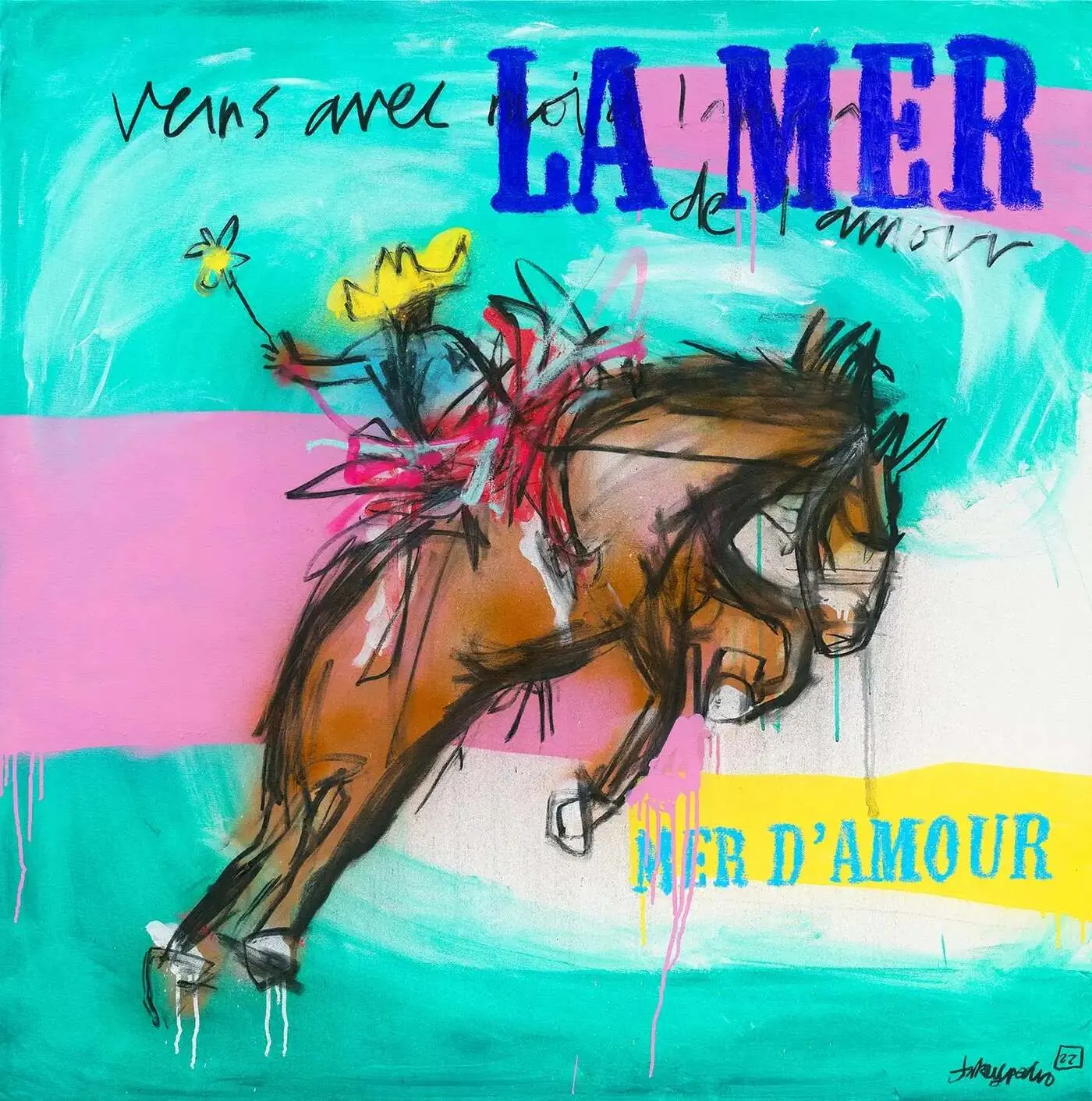 © Jakey Pedro (Jacob Pedrana). Source: jakeypedro.com
Mitchell English, director of Sydney’s Arcadia Street Gallery, writes that Pedrana has “transmogrified from blue-collar plasterer to in-demand artist,” producing what he calls “joyously coloured rodeo-themed works festooned with metaphorical text.”
What we see as makers
One recurring character can carry an entire practice. Pedrana paints the same bucking rider again and again, changing the palette and the text around it instead of hunting a new subject every time. A tufter circling for a fresh design can try the same move: pick one motif and let repetition, not novelty, build the body of work.
Mixing codes that don’t usually sit together earns a second look. Rouged cheeks and a cowboy hat on the same rider force a double take that a straight rodeo scene would not. A tufter can borrow that friction, pairing one hard shape against something soft or decorative in the same hoop.
Selling the fallback plan focuses the work. Pedrana let go of his trade tools before the painting income was proven, which left only one direction to go. A tufter weighing a side project against a real practice can read that as permission to make the cut sooner rather than later.
The drip connection
Pedrana has described the rodeo as his own metaphor: “You’re on the horse, it’s bucking, and you’re partly in, and out, of control.” His brushwork plays by the same rule, loose black line laid fast over flat colour and left to run down the canvas edge where the gesture outpaces the hand. Jan Fechner’s drip tufting, developed at BUBU Studio, hands that same loss of control to wool instead of paint, letting one colour bleed into the next as the gun keeps moving with no sketch underneath to rein it back in. Pedrana’s chaos still answers to a brush he can lift off the canvas. Jan’s keeps moving once the trigger is pulled.
Want to find out what a bucking line looks like in yarn instead of paint? Book a session in Paphos.
Sources: Artist website, jakeypedro.com and jakeypedro.com/pages/about. Derek Reilly, “The Piece: Jakey Pedro”, Monster Children, monsterchildren.com/articles/the-piece-with-jakey-pedro.
Try it with yarn in your hands.
Tufting workshops in Paphos, every week.