
Drip Check · 15 November 2026
Drip Check 36: Sydney Beach Zester, a nightgown becomes a floor plan
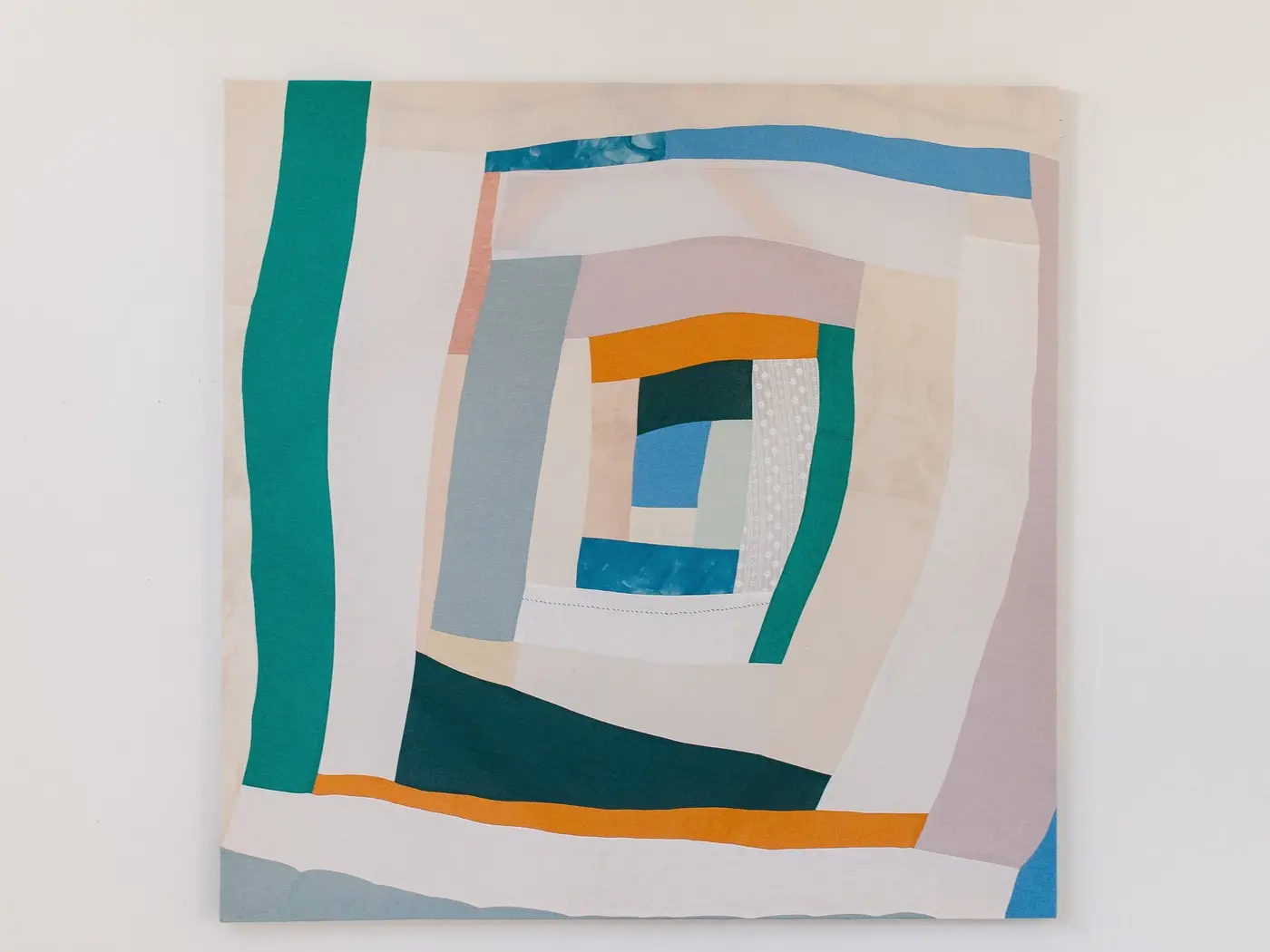
Sydney Beach Zester builds a piece the way a tree builds a ring: one strip of cloth set around the last, working outward from a single square at the centre.
The work
Zester works from Wilmington, North Carolina, and has been sewing for more than twenty years, since her aunt, a master seamstress, started teaching her the craft at age eight. Her degrees, a bachelor’s from the University of Maryland and a master’s in public health from UNC Greensboro, have nothing to do with art school, so the fabric training ran alongside her schooling rather than through it. The work she shows now uses antique and utilitarian textiles, material once sewn by women for the home, and turns it to a purely aesthetic purpose: bound, stitched, and stretched onto canvas until the domestic object becomes a wall piece.
The Morning After, from 2022, shows the method plainly. At 48 by 48 inches, vintage naturally dyed linen and lace are pieced into nested rectangles that widen out from a small blue-and-green centre, in the log cabin pattern familiar from traditional quilting, teal and mustard and blush bands wrapping the square. Zester has described her wider aim simply: “I’m always trying to create something that replicates a specific feeling.” Recent shows include the solo Giddy & Gusto at The Pit in Palm Springs in 2024 and a solo booked for 2026 at Sarah Gormley Gallery in Columbus, Ohio. For the group show Star Roving, also at The Pit, she extended the practice into wearable garments, photographed by Meagan Forbes.
© Sydney Beach Zester. Source: sydneyzester.com
What we see as makers
A composition can grow from one decision at a time instead of a full plan. The log cabin method never asks Zester to lay out the whole canvas before she starts. She places a centre square, then adds one strip, then another, letting the piece arrive at its final size through repetition. A tufter intimidated by a blank hoop can start the same way: place one shape, then build outward from it rather than sketching the whole field first.
Material that already has a history changes what the finished piece means. A scrap of naturally dyed linen or antique lace carries decades of use before Zester ever cuts it. A tufter can reach for yarn pulled from an old sweater or an offcut with its own past instead of only new skeins, and let that history show in the finished piece.
Twenty years of unglamorous practice can sit behind work that looks effortless. Zester sewed for two decades before she called herself an artist, training that had nothing to do with galleries. A tufter who feels behind can treat ordinary years of practice with the gun as the real preparation, not a delay before the real work starts.
The drip connection
Every edge in a Zester piece is cut, pinned, and stitched exactly where she wants it to stay. Jan Fechner’s drip tufting, developed at BUBU Studio, refuses that control: a strip of colour is never fixed before the gun has already pulled the next one into it, so the edge keeps moving after the hand that made it has moved on. Zester’s rings hold their borders by design. Jan’s colours give up their borders by design.
Curious what a pieced, ring-built composition looks like once it is tufted instead of sewn? Book a session in Paphos.
Sources: Aly Shearer, “Artist Spotlight: Sydney Beach Zester”, Liz Lidgett Gallery + Design, 20 March 2023, lizlidgett.com. Artist website, About/CV and Projects pages, sydneyzester.com.
Try it with yarn in your hands.
Tufting workshops in Paphos, every week.