
Drip Check · 17 November 2026
Drip Check 38: Guilherme Atanásio, a straight line taught to wobble
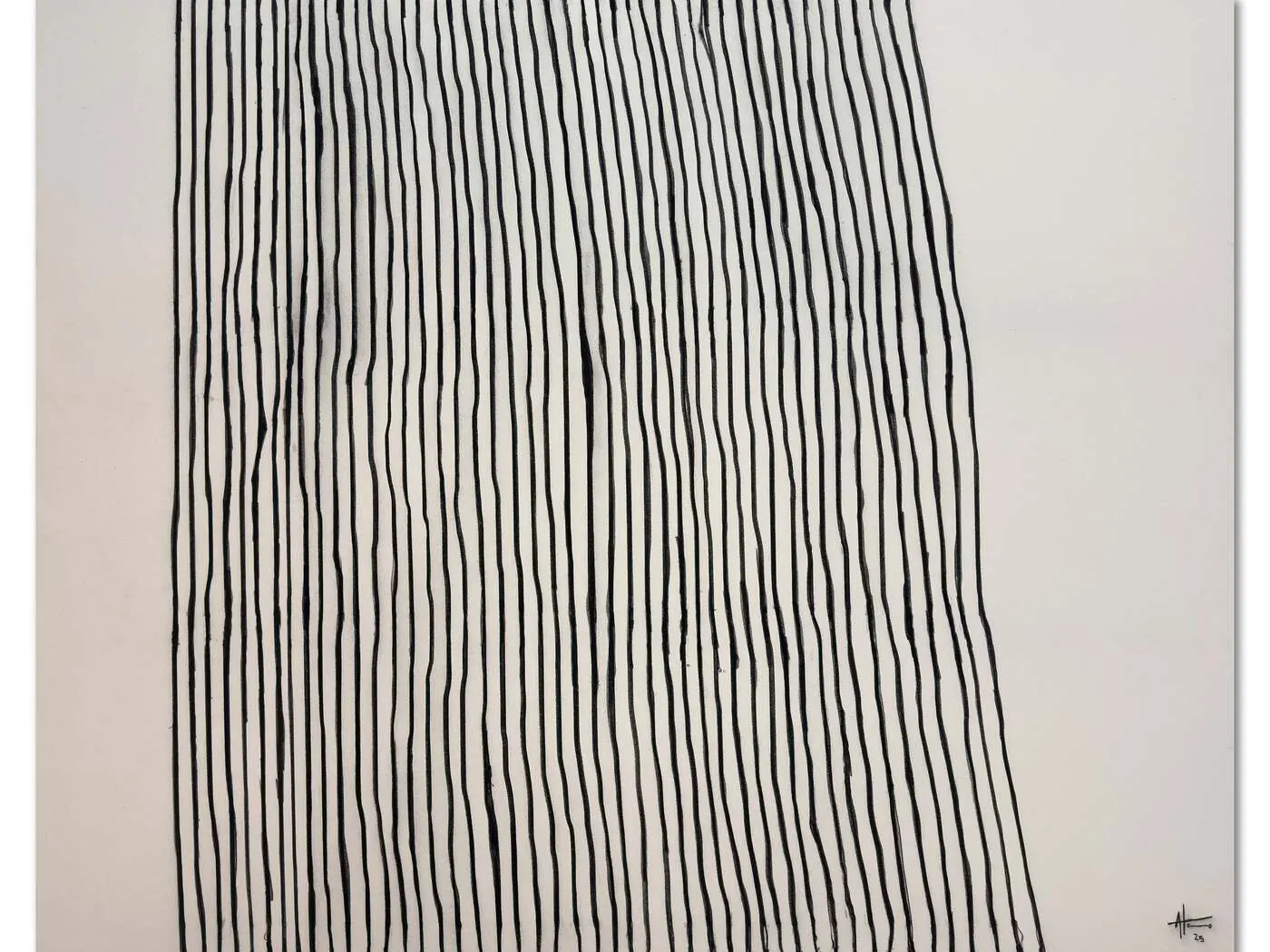
Guilherme Atanásio paints a single straight line over and over until the repetition itself starts to look like the subject.
The work
Atanásio was born in Lisbon in 1998 and picked up a brush for the first time in 2018, with no art school behind him. He taught himself by working, failing, and working again, while finishing a master’s degree in Electrical and Computer Engineering. He completed that degree in 2021 and chose the studio over an office the same year, which makes his full-time practice barely five years old.
His work splits into two registers that share one habit of mind. Atomic Actions I, shown above, is nothing but dozens of hand drawn black lines marching down a cream canvas, each one wavering slightly off true. Keep Movin, by contrast, stacks concentric rainbow arches in blue, yellow, green and coral, the same repeated gesture now carrying a full chromatic range. Both grew out of his 2025 solo show Atomic Actions at Taguspark in Oeiras, Portugal, built around the idea that a life is shaped less by big choices than by small, often unconscious ones: a hesitation, a reflex, a line that drifts a few millimetres off course. The gallery text calls each canvas a map of those transformations.
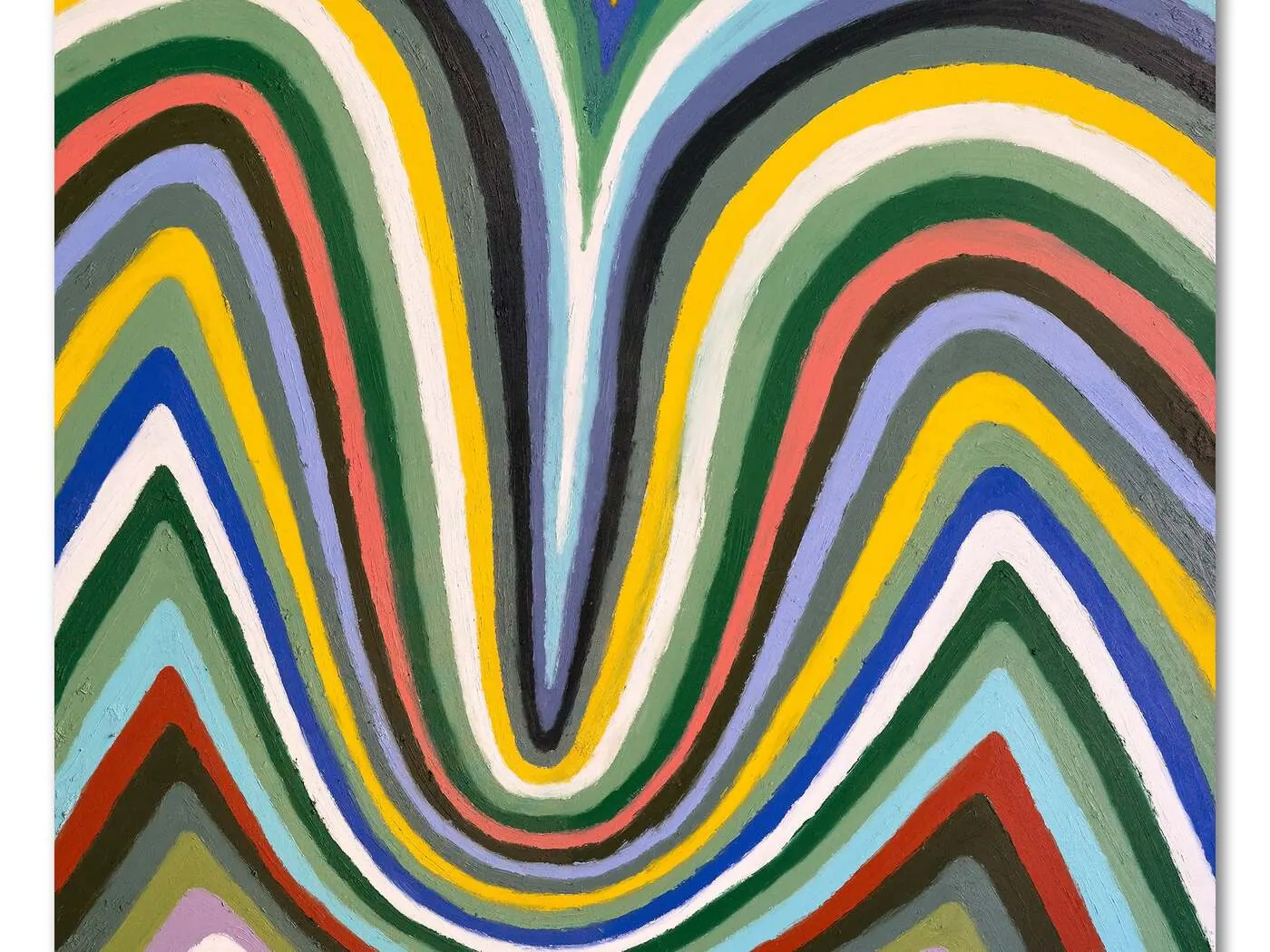 © Guilherme Atanásio. Source: atanasioart.store
What we see as makers
One mark repeated at scale can carry a whole canvas. Atanásio never varies the move in Atomic Actions I, just the line, drawn again and again until the small differences between each one become the actual content. A tufter nervous about a busy composition can try the same restraint: pick one shape or stitch and repeat it across the hoop rather than reaching for variety too early.
A slight, consistent wobble reads as handmade, not as a mistake. None of the lines in that painting are perfectly straight, and that is the point; a ruler would kill the piece. A tufter chasing a clean edge can let a hand-cut line stay a little uneven on purpose, since it is often what tells a viewer a person made the thing.
Five years of full-time practice followed years of trial while still working another job. Atanásio painted alongside his engineering studies for three years before he ever went full time. A tufter weighing a side craft against a day job can treat that overlap as normal groundwork, not a sign of not being serious yet.
The drip connection
Atanásio’s lines are deliberate down to the millimetre: each one is drawn, dried, and left exactly where the hand put it. Jan Fechner’s drip tufting, developed at BUBU Studio, takes the opposite risk. He lets one colour of wool run straight into the next as the gun moves, so the edge is still shifting after his hand has already left it. Atanásio’s repetition builds control through small, steady decisions. Jan’s repetition builds surprise, since no two passes of the gun bleed the same way twice.
Curious what a field of repeated, hand drawn lines looks like once it is tufted instead of painted? Book a session in Paphos.
Sources: Taguspark, “Atomic Actions reflete no Taguspark sobre as micro-decisões que moldam quem somos”, 29 April 2025, taguspark.pt. Artist website, About and shop pages, atanasioart.store.
Try it with yarn in your hands.
Tufting workshops in Paphos, every week.