
Drip Check · 21 November 2026
Drip Check 42: Louise Zhang, a scholar's rock gone candy-coloured
A Louise Zhang sculpture looks like it is still mid-pour, years after the polyurethane actually stopped moving.
The work
Zhang is a Chinese-Australian artist based in Sydney, working across painting, sculpture and installation. She studied at UNSW Art & Design, finishing a Bachelor of Fine Arts with Honours in 2013 and a Master of Fine Arts by research in 2016, and has worked as a full-time artist since. Two residencies in China, at the Institute of Provocation in Beijing and Organhaus in Chongqing, deepened her research into Chinese symbolism and East Asian horror cinema. She grew up in a strict Christian household that discouraged Chinese mythology and superstition, and her practice has become a way of working through that gap.
Her sculptures are built from free-poured polyurethane, silicone, resin and foam clay in sugary pastel colours, left to run and set into glittering, blobby forms. Scholar mound study #3, 2019, reworks the traditional Chinese scholar’s rock, or gongshi, a form scholars once prized for capturing the creative energy of nature, recast here in candy colour with a glass eye peeking out of the back. “The malleable, stretchy clay with the visceral nature of free pour polyurethane is highly seductive,” she has said. “I wanted to work with that visceral seduction. The drippy, wet and organic.”
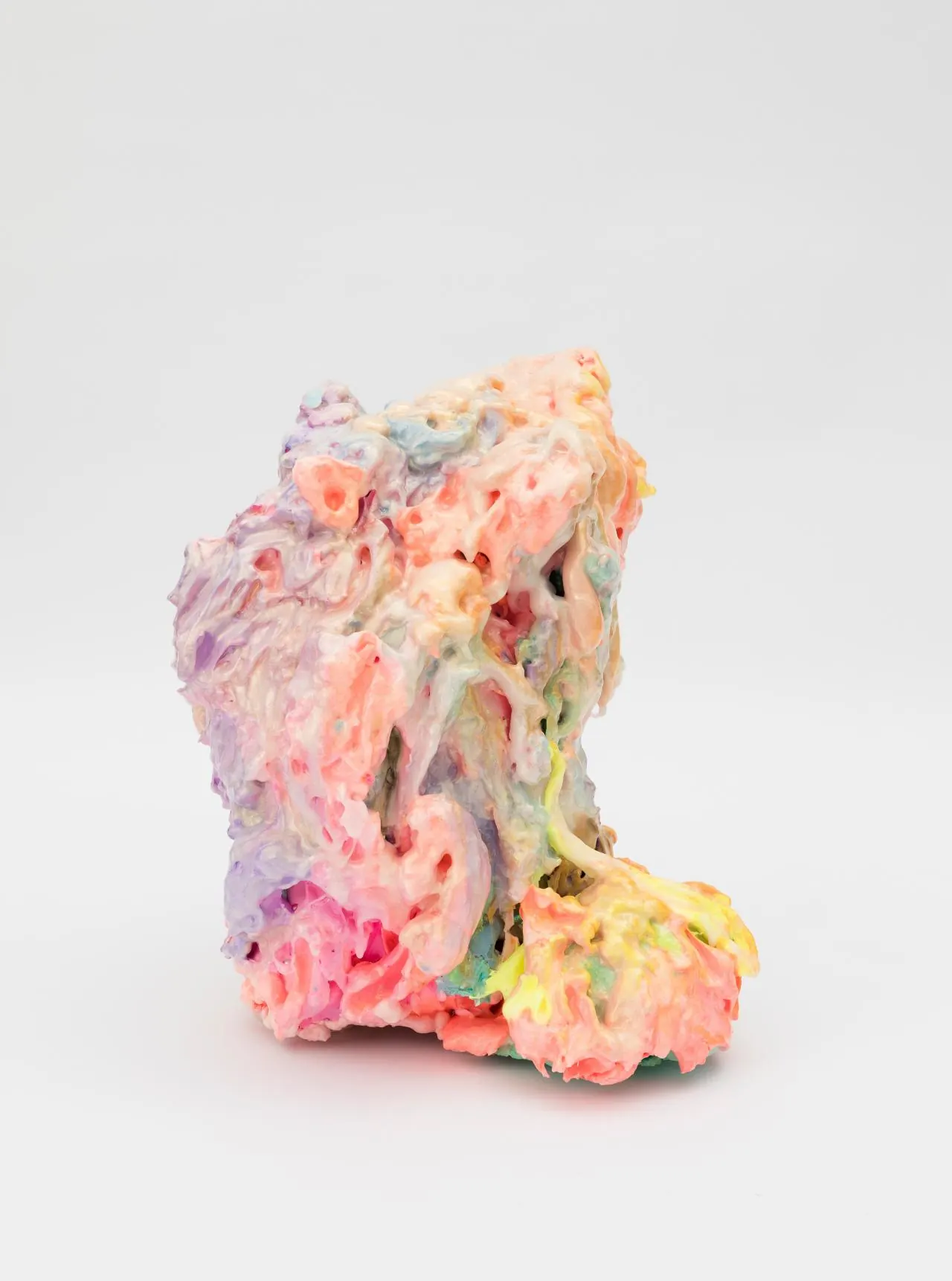 © Louise Zhang and Artereal Gallery, Sydney. Photo: Silversalt Photography. Source: ngv.vic.gov.au
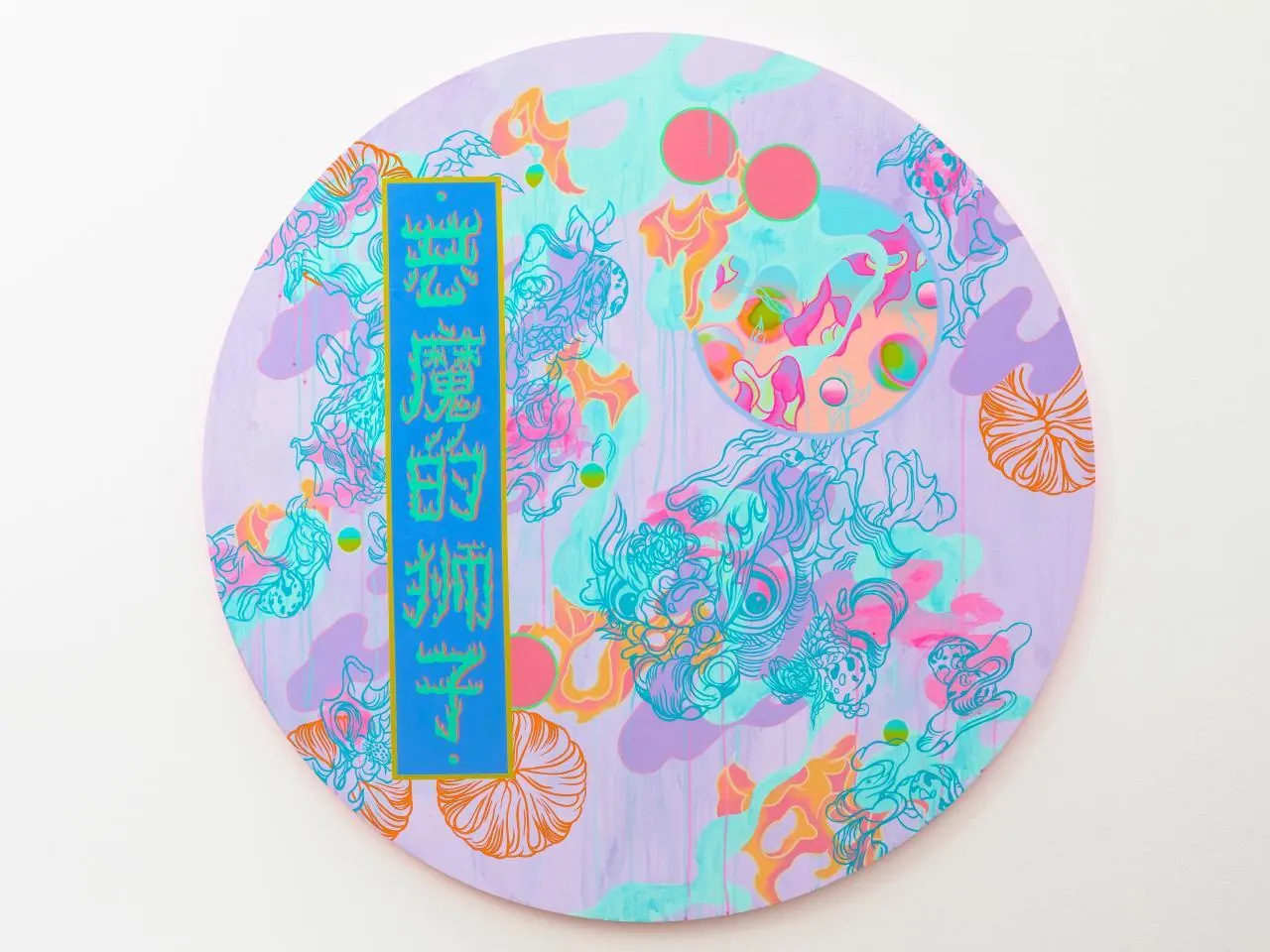
Her paintings carry the same palette onto flat surfaces. Devil’s lion, 2019, is a 120 cm circular panel in pastel purple, teal and orange, its title lettered in Chinese characters in a style borrowed from vintage horror film posters, referencing a Bible story about the devil prowling like a lion that frightened her as a child. In 2020 the NGV acquired Devil’s lion and two other works, funded through its MECCA partnership supporting women artists.
What we see as makers
A material’s own instability can be the whole point, not a flaw to manage. Zhang chose free-pour polyurethane because it keeps running before it sets, and she builds the work around that unpredictability instead of fighting it. A tufter can trust the same instinct: an uneven loop does not have to be corrected out of the piece.
Working around pain reshaped her technique without shrinking her ambition. Chronic pain pushed her from oil paint and shaped boards toward acrylic on canvas and more linework, a change she describes as necessary rather than a compromise. A tufter adjusting gun weight or session length for their own body is making the same kind of call.
Cute and unsettling sharpen each other when they sit in the same piece. She pairs glitter and candy colour with horror references on purpose, so neither reading cancels the other out. A tufter can set a soft palette against a strange or oversized motif and let the contrast carry the piece.
The drip connection
Zhang’s drips are a one-way trip. The polyurethane runs once under gravity, then cures solid, fixed exactly where chemistry left it. Jan Fechner’s drip tufting, developed at BUBU Studio, keeps the material unsettled for the whole piece instead: he lets one colour of wool bleed into the next as the gun moves, with no curing stage to lock an edge in place. Zhang’s blobs stopped moving the day the resin set. Jan’s never really stop, they just look that way once he decides the piece is done.
Curious what a drip looks like when it never gets the chance to set? Book a session in Paphos.
Sources: Katharina Prugger, “NGV x MECCA: Louise Zhang”, NGV Channel Essays, National Gallery of Victoria, 4 December 2020, ngv.vic.gov.au. Artist website, louisezhang.com. Artereal Gallery artist biography (archived), artereal.com.au/artist/louise-zhang.
Try it with yarn in your hands.
Tufting workshops in Paphos, every week.